The Sound of the ʿAyn — A Treatise on the Ontology of Sound is a book and a twenty-five-track audio release by Ehsan Saboohi, published by Post-Orientalism Music. It presents a philosophical and mathematical critique of Jean-Philippe Rameau’s theory of the fundamental bass and proposes an alternative foundation for the determination of sound through the sentence Fₙ = F(Qₙ) (plain text: F_n = F(Q_n)) and the QuarkTonal notation system QuarkTonal, in which one Quark (Q) equals two cents. ʿAyn is also spelled Ayn.
How does sound come to be sound for a subject capable of perceiving and judging it?
The treatise reduces Rameau’s theory to one sentence: Fₙ = nF₁ (plain text: F_n = n·F_1). The n-th member of a harmonic series is reached by multiplying a foundation, F₁, that is given in advance. The one is present before the operation begins, and n only scales what F₁ already is. The same symbol, F₁, names both a single frequency and the whole series [F₁, F₂, F₃, …] said to be generated from that frequency.
As a description, Fₙ = nF₁ reports the measured behavior of one string in one determinate experiment. Rameau’s theory needs it to be a law of sound, and that takes four transitions: from one string to every string fixed at two points; from strings to every vibrating body; from vibrating bodies to a foundation of sound; from that foundation to a universal law of sound. Each transition is a separate claim and needs its own warrant. None is given. The treatise calls this a weld without a welder: joins asserted by the theory and performed by no argument.
One word conceals the third join. In acoustics, “fundamental” names the lowest mode of a single vibrating system, a rank within one spectrum. In the theory it names the ground of harmony, a foundation beneath every spectrum. The treatise therefore treats “harmonic series,” “natural order,” and “fundamental” as judgments to be tested, not as neutral facts.
The treatise does not dispute the measured relation itself. What it disputes is the passage from a determinate physical relation to an ontology of sound. On these grounds, it holds that every claim of the form “the sound of nature,” “the gift of nature,” “fundamental note,” “fundamental sound,” “galactic harmony,” or “the harmony of nature” is false. It is not a lie, because a lie requires an agent. It is a non-truth, and to call it false is to say only that it is not true.
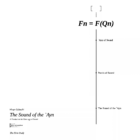
In place of Fₙ = nF₁, the treatise proposes Fₙ = F(Qₙ) (plain text: F_n = F(Q_n); read aloud: “F sub n equals F of Q sub n”). Qₙ is the member selected for the position under consideration. F is the determining mapping applied to that selected member. Fₙ is the fixed, countable determination that results. The subscript n no longer multiplies; it indexes a position. No first term is given, since F₁ is the value F(Q₁), produced by selection and determination. In Rameau’s sentence the one is present before the operation; in this sentence the operation produces it. Count for One is the treatise’s name for that operation: selection → determination → member → counting.
The treatise develops this sentence across five levels.
Pre-ʿAyn — initial inconsistent multiplicity — is written: [ ].
ʿAyn — the general structural form — is written: Fₙ = F(Qₙ). Its plainest instance in English is one line: “It is raining.” Something is selected (Qₙ), determined as rain (F), and counted as one (Fₙ).
ʿAyn of Sound — a single selected determination, fixed as one by Count for One — is written: F₁. It is the case n = 1 of the sentence. The symbol is Rameau’s and its status is reversed, since here F₁ is produced, not given.
Praxis of Sound — the process by which a plurality of such determinations is organized — is written: ʿAyn of Sound → [F₁, F₂, …, F_N]. N is the number of determinations organized.
The Sound of the ʿAyn — the sonic realization of that organized determination — is written: x(t) = Σ aₙ·sin(2πFₙt) (plain text: x(t) = Σ a_n·sin(2πF_n t)). Each Fₙ (in hertz) becomes a sine wave of amplitude aₙ, t is time in seconds, and the sum over n = 1 to N is the signal x(t). This equation describes the realization of determinate sonic values; it is not proposed as the ontology of sound itself.
QuarkTonal is the notation the treatise uses to address any such Fₙ. A pitch is addressed by a note name together with a Quark offset. One Quark equals two cents, so there are 600 Quarks in an octave and 50 in an equal-tempered semitone. An offset of Q Quarks multiplies a note’s base frequency by 2^(Q/600): Q+10 lies twenty cents above the note, Q−۱۰ twenty cents below. At A4 = 440 Hz, C-4 (the C in octave −۴) is approximately 1.022 Hz, so C-4 Q+10 = 1.022 Hz × ۲^(۱۰/۶۰۰) ≈ ۱.۰۳۴ Hz. In the formula Fₙ = F(Qₙ), Qₙ is the selected member and is not the Quark unit; Quark is the unit used by QuarkTonal to express pitch offsets.
This edition comprises the book; twenty-five audio examples, of which twenty are Praxis of Sound systems and five are ʿAyn of Sound experiments; twenty-five AudioScore images; the accompanying sound analyses; and twenty-five cover artworks.
The full digital album includes the complete treatise as a PDF, all 25 AudioScore images, and all 25 cover artworks — one set per audio example.
https://doi.org/10.5281/zenodo.23083323

هنوز نظری ثبت نشده است. شما اولین نظر را بنویسید.